Destination briefing
Why travelers stop here
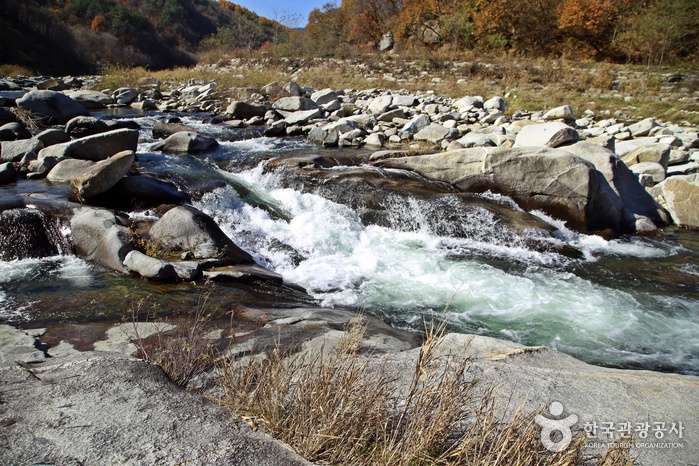
Gokun Gugok corresponds to a section of Jicheon Stream, a tributary of the Bukhangang River. Along the riverbed made of hard granite, diverse river landforms have developed, and it is an important geological site where folds and fault structures of Precambrian metamorphic rocks can be observed. It is named after the pen name 'Gokun' of Kim Su-jeung (金壽增, 1624–1701), a Neo-Confucian scholar of the Joseon Dynasty. He resided in Yeongdang-dong, Sanae-myeon, Hwacheon-gun from 1670 and named nine bends of Jicheon Stream as 'Banghwague (榜花溪), Cheongokhyeop (靑玉峽), Sinnyeohyeop (神女峽), Baegundam (白雲), Myeongongnoe (鳴玉瀨), Waryongdam (臥龍潭), Myeongwolgye (明月溪), Yunguiyeon (隆義淵), and Cheopseokdae (疊石坮)', calling it Gokun Gugok. This was to realize the ideal of Neo-Confucianism, which seeks to devote oneself to scholarship through seclusion and tranquility, retreating from the mundane world into deep mountains and secluded valleys. The area's stream is relatively small in scale, and some of the remaining landforms were lost during road construction, but overall, it is regarded as an excellent resource not only in terms of gugok culture but also as a geomorphological landscape, due to its beautiful rock scenery based on granite and its cleanliness. Among the nine bends, the most scenic are the 3rd bend, Sinnyeohyeop, and the 4th bend, Baegundam, located in granite areas. Meanwhile, in the metamorphic rock (banded gneiss) area between the 1st and 3rd bends, fold and fault structures that occurred during metamorphism can be observed. (Source: Gangwon Peace Area National Geopark)
OTA-ready stop
Built into inbound routes and day-tour planning.
Local context
강원특별자치도 화천군 사내면 물안골길 13
Travel fit
Attraction · Gangwon-do

![[Early bird] Elysian Gangchon Ski & Snowboard Gugok Ice Wall Tour](/_next/image?url=https%3A%2F%2Fadmin.holidaykr.com%2Fapi%2Fadmin%2Fsystem%2Fbasic-settings%2Ffavicon%3Fpath%3D%252Fuploads%252Fproducts%252Fthumbs%252F750_1791455110103_file1.jpg&w=3840&q=75)