
The old capital of Silla in detail: five UNESCO zones, Bulguksa and Seokguram, tombs, Wolji, Hwangnidan-gil, Namsan, Yangdong, admission fees and hours, KTX and bus 10, food, festivals, and ready-made 3- and 5-day plans.
Overview
Gyeongju was the capital of the Silla kingdom for nearly a thousand years, from 57 BC to AD 935, and the remains of that capital lie scattered through an ordinary modern town: royal burial mounds, palace ruins, a stone observatory, temple sites and hillside Buddhist carvings. That is why the city is often called a museum without walls.
Three groups of sites are on the UNESCO World Heritage list: Bulguksa temple and the Seokguram grotto (December 1995), the Gyeongju Historic Areas (December 2000) and Yangdong Village, which was inscribed in July 2010 together with Hahoe Village as the Historic Villages of Korea.
The sights are in clusters. The historic center, with the tumuli park, Cheomseongdae, the palace pond and Hwangnidan-gil, lies within about a 2 km radius and is best walked or cycled. Bulguksa and Seokguram are on a hillside east of the city, 35 to 45 minutes by city bus. Bomun Lake is the resort area, Namsan the sacred mountain to the south, and Yangdong Village lies in the countryside to the north-east. Plan two or three days.
The five UNESCO zones of the Historic Areas
The Gyeongju Historic Areas, inscribed in December 2000, are made up of five districts: Namsan, Wolseong, Daereungwon (the tumuli), Hwangnyongsa and Sanseong (the Myeonghwal hill fortress). They are scattered across the city, so the guide treats them one by one in the sections below.
In brief: Namsan is the mountain Silla people held most sacred, with temple sites, rock-cut Buddhas, royal tombs and the legendary birthplace of the first king (about 25 km² is protected). Wolseong was the crescent-shaped palace fortress, where the capital moved in AD 101, and it includes the sites of Cheomseongdae and the Donggung palace pond. Daereungwon covers the great tumuli around Cheonmachong, and the five old burial groups were merged into one protected area of about 0.6 km² in 2011.
Hwangnyongsa was Silla's greatest temple: begun in AD 553, it took 93 years to complete and held a nine-story wooden pagoda, until Mongol invaders burned it in 1238, and only the foundations remain on a site of about 0.39 km². The Myeonghwal fortress is a hilltop wall of about 6 km, recorded in AD 405, on the hills east of the city near Bomun. The temple site and the fortress are free and open at any time; the paid sites are covered below.
Best time to go
Spring brings the Gyeongju Cherry Blossom Festival, held each year around the blossom, usually in early April, in the eastern historic zone (Cheomseongdae and Gyerim) and the Bomun resort area. The city lists cherry-lined spots at the Daereungwon stone wall lane, the Bomun lakeside, Wolseong and the Hwangnyongsa Maru-gil path, and canola fields at the Cheomseongdae flower park (as of 2026-10-11).
Summer brings lotus flowers to the ponds at Donggung and Wolji, Yangdong Village and Seochulji, and purple lily-turf at Hwangseong Park; the days are hot, so visit temples in the morning and the palace pond after dusk. Autumn is the second peak: pink muhly grass at Cheomseongdae, cosmos along the Hwangnyongsa Maru-gil, autumn color at Poseokjeong and the Silla Cultural Festival in October. In winter, the second botanical hall at Donggungwon fills with poinsettias (as of 2026-10-11).
Getting there
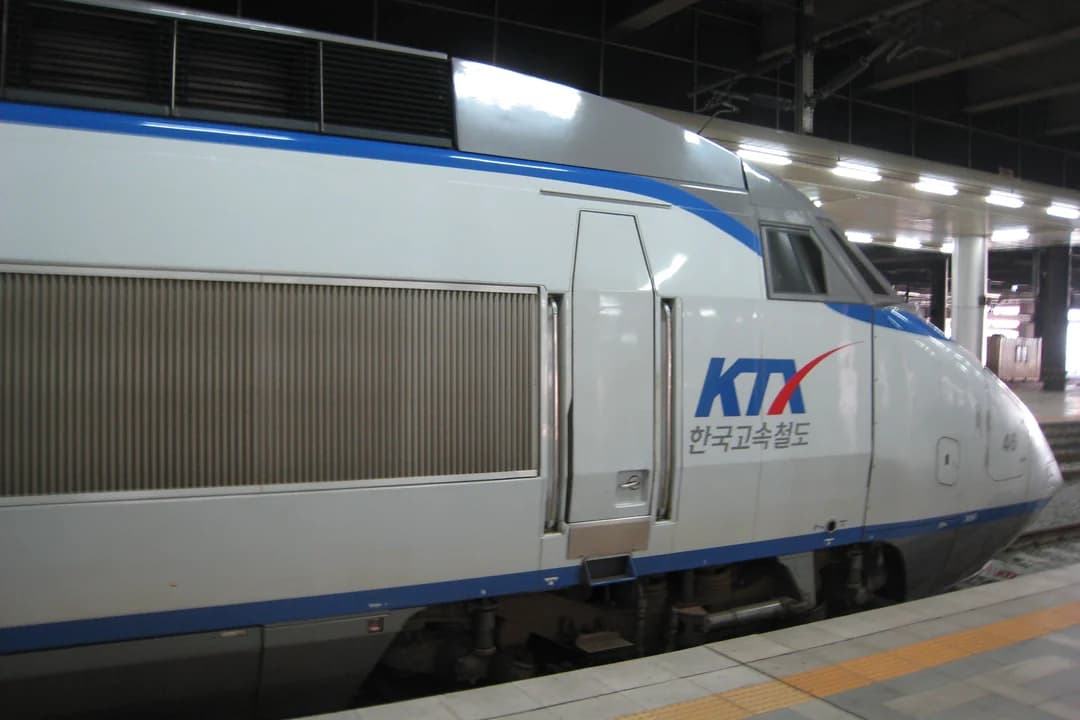
The KTX stops at Gyeongju Station in Geoncheon-eup, west of the city; the station used to be called Singyeongju and some older maps still use that name. The city gives about 2 hours 10 minutes from Seoul Station, 30 minutes from Busan and 20 minutes from Dongdaegu, with trains about hourly on the Gyeongbu line. The station has a tourist information desk (open all year, with English, Japanese and Chinese help) and coin lockers: ₩1,000 for a small locker for two hours, ₩1,500 medium and ₩2,500 large (as of 2026-10-11).
Buses are the alternative: express buses from Seoul take about 3 hours 30 minutes and intercity buses about 4 hours, while buses from Daegu and Busan take about 50 to 70 minutes. The Gyeongju express and intercity bus terminal is in Noseo-dong, a 5 to 10 minute walk from Hwangnidan-gil and the tumuli park, and it has its own tourist desk that is open all year (as of 2026-10-11).
From the KTX station to the sights, take a city bus or taxi into the center; the Bulguksa temple site lists bus 700 from the station to Bulguksa, running four times a day. Beware of the name: bus stops called "Gyeongju Station" in the downtown refer to the former station, which is no longer in service and sits about a 15-minute walk from the tumuli park.
Getting around
The city's "golden route" is bus 10, with bus 11 running the same loop in the opposite direction. It links the terminal, Cheomseongdae, Donggung and Wolji, Bunhwangsa, the Donggungwon garden, the Bomun resort area and Bulguksa. Going straight from the terminal to Bulguksa takes about 35 to 45 minutes, buses come about every 20 minutes, and the first bus leaves at 06:00 and the last at 21:40 from the terminal. Transfers are free only when changing to another route, so riding bus 10 twice means paying twice (as of 2026-10-11).
The tumuli park, Cheomseongdae, the palace pond and Hwangnidan-gil are all within about 2 km of each other, so walking is easiest; the night market at Jungang Market is about 2.7 km from the palace pond. The city runs an unmanned public bicycle system called Tasilla, and bike-hire shops stand near the tumuli park; a flat half-day loop of about 12 km covers Woljeonggyo, the Five Tombs, Najeong, Poseokjeong, the Baeri Buddhas and Samneung. There is also a battery-powered sightseeing car in the tumuli area.
Daereungwon, Cheonmachong and Geumgwanchong
Daereungwon is a park of grass-covered royal tumuli in the middle of town. The park itself is free; the one tomb you can walk into is Cheonmachong, excavated in 1973 and named after the flying horse painted on a birch-bark saddle flap found in it. The tomb dates from the late 5th or early 6th century. Its gold crown is the largest and most elaborate crown excavated so far, but the original finds are shown in the Gyeongju National Museum; what you see inside are replicas.
The park is open 09:00 to 22:00 with the last ticket at 21:30. Entry to Cheonmachong costs ₩3,000 for adults, ₩2,000 for youths and soldiers and ₩1,000 for children. A combined ticket for Daereungwon and Donggung and Wolji costs ₩6,000 for adults, ₩4,000 for youths and ₩2,000 for children, is valid for one day, and one printed ticket can be issued for a whole party. Wheelchairs and strollers can be borrowed at the front-gate ticket office, and the paths inside are flat. Admission is free for children aged six and under, people over 65, disabled visitors and Gyeongju residents (as of 2026-10-11).
Next to the park, the Geumgwanchong tomb and the Silla Tomb Information Center let you look into a second tomb under a dome. The gold crown that gave the tomb its name was found in 1921 in a farmhouse, the site was re-excavated in 2015 and dated to the Maripgan period (AD 356 to 514), and the building reproduces the construction of a Silla stone-mound wooden-chamber tomb at full size. It is open 09:00 to 18:00 and closed on 1 January, Seollal and Chuseok.
Cheomseongdae, Wolseong, Donggung and Wolji
Cheomseongdae is a stone observatory about 9 m high: a bottle-shaped cylinder of 27 courses of fan-shaped stones on a square base, with a window in the south-east and a square crown. It is thought to have been built during the reign of Queen Seondeok (632 to 647) and is regarded as the oldest observatory in East Asia. It stands in the Wolseong district beside the Gyerim forest, is free, and its grounds are open 09:00 to 22:00 (to 21:00 in winter) all year (as of 2026-10-11).
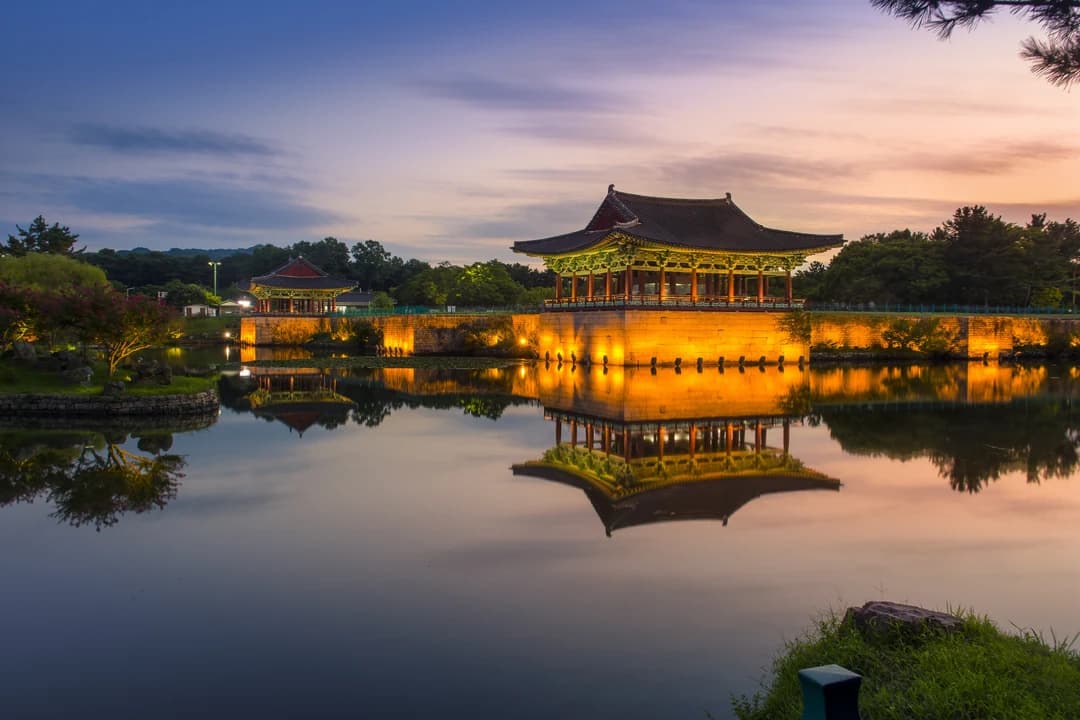
Wolseong, the crescent-shaped palace fortress where the Silla kings lived, lies behind it. Donggung and Wolji was the crown prince's palace and the banquet ground of the Silla court. In AD 674 King Munmu had a large pond dug with three islands and twelve small hills, planted flowers and kept rare birds and animals there. About 30,000 relics were found in the pond, and the Gyeongju National Museum shows a selection. Three of the five excavated pavilion sites on the west bank have been rebuilt.
Donggung and Wolji is open 09:00 to 22:00 all year with the last ticket at 21:30, and adults pay ₩3,000, youths ₩2,000 and children ₩1,000; parking is free. It is Gyeongju's best-known night view, and because of the crowds the city warns that you may be refused entry if you arrive just before the closing time. Come at dusk to see both the daylight pond and the lit pavilions, and use the combined ticket if you also visit Cheonmachong (as of 2026-10-11).
Nearby are Bunhwangsa and the Hwangnyongsa site. Bunhwangsa, built in 634, keeps a brick-style stone pagoda that is National Treasure No. 30 and a well that is said never to dry up; it is open 08:00 to 18:00 (to 17:00 in winter) and free. The Hwangnyongsa temple site is a wide field of foundation stones, free and open at any time; its history center is closed from 1 July to 20 November 2026 for an exhibition rebuild (as of 2026-10-11).
Hwangnidan-gil, Gyochon and Woljeonggyo
Hwangnidan-gil is the city's youngest street, running from the Naenam crossroads to the Hwangnam Elementary School crossroads through Hwangnam-dong and Sajeong-dong, with cafes, small shops, souvenir stores and restaurants in low old houses. It is the place for coffee and snacks between sights and is usually busiest from late afternoon. The Hwangnidan-gil Living Culture Center offers one free luggage-storage use (10:00 to 18:30), and paid lockers in nearby shops cost ₩3,000 to ₩7,000 depending on size (as of 2026-10-11).
Gyochon Hanok Village is a quiet quarter of traditional houses beside the Gyerim forest. It is free and has no set opening hours. It holds the old house of the Gyeongju Choi family, the "Choi the rich", an Important Folk Material (No. 27) whose family kept six rules, including never holding office above a certain rank, never owning more than a fixed amount of land and feeding passers-by, and the Gyodong beopju rice wine, an Important Intangible Cultural Heritage. Workshops offer pottery, rice-cake pounding, tea, hanbok, traditional sauces, noodles and quilting.
Woljeonggyo is a restored timber bridge over the Namcheon stream: its Silla predecessor is recorded in the 19th year of King Gyeongdeok, the bridge itself was rebuilt by 2013 and the gate towers were finished in April 2018. The towers hold an exhibition on the rebuilding and excavated relics. It is free and open 09:00 to 22:00 and is at its best lit at night, with a stepping-stone path in the river for photographs (as of 2026-10-11).
Bulguksa and Seokguram
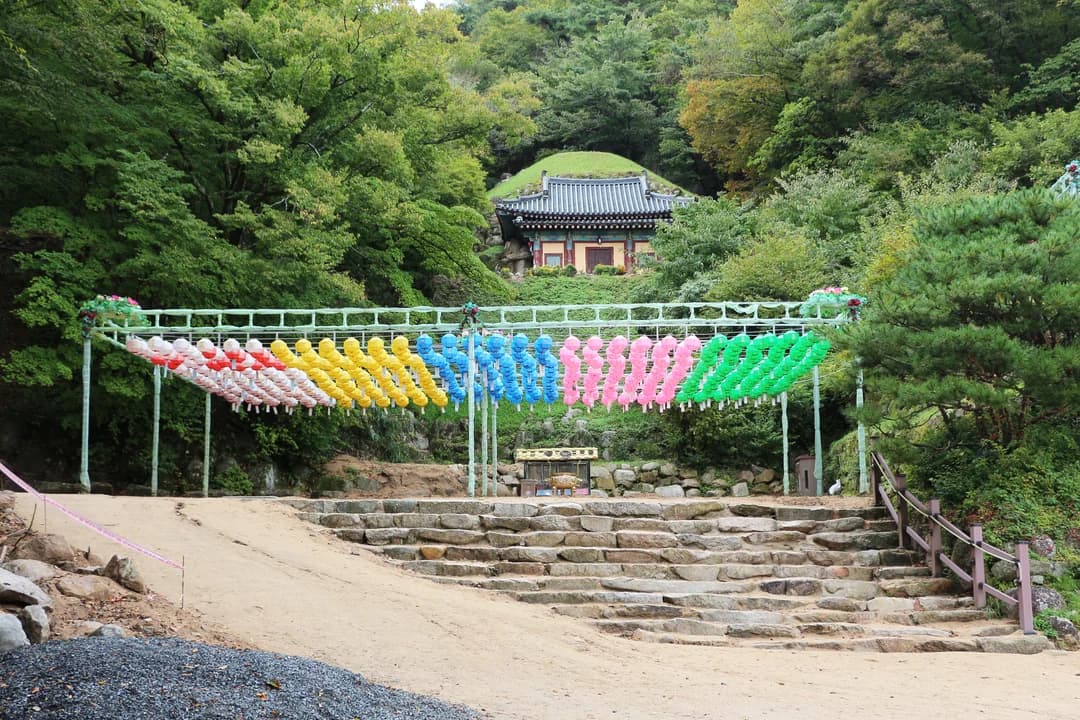
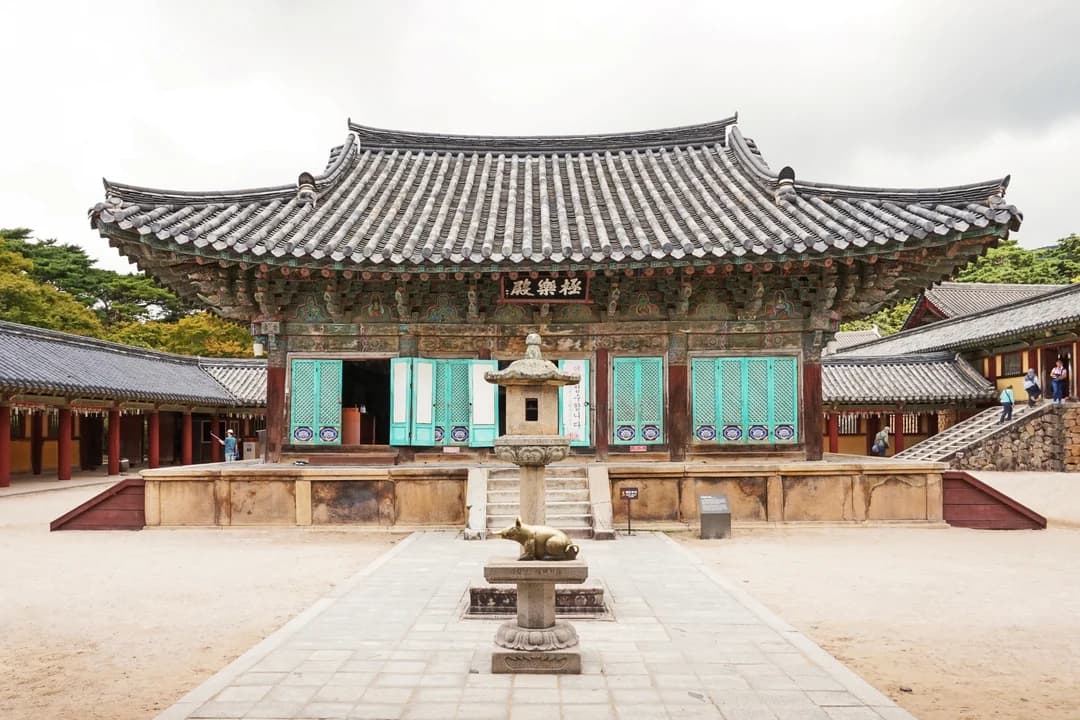
Bulguksa, on the slopes of Mount Tohamsan, was begun in AD 751 by the minister Kim Daeseong and finished in 774. Most buildings burned in the Japanese invasion of 1593 and were rebuilt after excavation between 1969 and 1973. The stone work from Silla survives: the Dabotap and Seokgatap pagodas and the Cheongun-Baegun and Yeonhwa-Chilbo stairway bridges are National Treasures. Bulguksa and Seokguram were inscribed together in December 1995.
Seokguram is a granite grotto on the mountain above, begun in 751 and completed in 774. Its round main chamber is roofed by a dome built from about 360 flat stones, one of the cleverest pieces of construction of its time. The seated Buddha is surrounded by guardians, bodhisattvas and disciples: 40 figures were carved and 38 remain. Visitors look in from the entrance hall, and photography inside is not allowed.
Both temples have been free to enter since 4 May 2023, and both are open every day and do not admit pets. Last entry is 18:00 from March to September, 17:30 in February and October and 17:00 from November to January; opening is 09:00. Seokguram may be closed on days with heavy rain, typhoon or heavy-snow warnings. Parking costs ₩2,000 for a car and ₩4,000 for a bus at both (as of 2026-10-11).
To get there, take bus 10, 11 or 700 to Bulguksa. From Bulguksa, bus 12 climbs to Seokguram, and the return bus leaves Seokguram on the hour; by car the road up Tohamsan takes about 20 minutes, then it is a 10-minute walk from the Seokguram car park to the grotto. Allow a half day for the two together and go early in the day (as of 2026-10-11).
Namsan and the western tombs
Namsan, the mountain south of the city, was the most sacred ground of Silla and is often described as an open-air museum of Buddhist art, with temple sites, stone Buddhas, pagodas, tombs and palace sites across the slopes. The first king, Park Hyeokgeose, is said to have been born at the well site of Najeong at its foot. The city has marked two walking routes, Samneung-ganeun-gil on the west and a route on the south-east side, each about 8 km one way from Woljeonggyo, and a flat half-day bicycle loop of about 12 km.
On the west side, the Five Tombs (Oreung) are the royal tombs of the first Park-clan kings, with the shrine Sungdeokjeon inside. Poseokjeong is a banquet site from the late Silla period: a 22 m abalone-shaped stone channel in which cups were floated, with a 6 cm drop to keep the water moving, and a famous autumn-color spot. The Samneung pine forest holds the tombs of three Park-clan kings, and the Baeri stone Buddha triad from the 7th century stands at the foot of the trail. Muyeol-wang's tomb lies on the western side, and the Unification Hall (Tongiljeon, built in 1977 with portraits of Muyeol, Munmu and Kim Yu-sin) at the southern foot of Namsan.
Fees and hours at these sites: the Five Tombs, Poseokjeong and Muyeol-wang's tomb each cost ₩2,000 for adults, ₩1,000 for youths and soldiers and ₩500 for children, and the Five Tombs and Poseokjeong are open 09:00 to 18:00 (to 17:00 in winter); the Unification Hall is free, open 09:00 to 18:00 (to 17:00 in winter); Najeong, Samneung and the Baeri Buddhas are free with no fixed hours (as of 2026-10-11).
Bomun Lake, the Expo park and Donggungwon
The Bomun resort complex, about 2.4 million pyeong (roughly 7.9 km²) around the artificial Bomun Lake, is where most hotels, condominiums and leisure facilities stand, and bus 10 stops at most of them. A path of about 7 km runs round the lake; it is mostly flat, but the Hoban 1 bridge and the stepping stones cannot be used with a wheelchair or stroller, so a detour is needed. Boat and leisure rides on the lake run 09:00 to 22:00 on weekdays and 09:00 to 23:00 from Friday to Sunday (as of 2026-10-11).
Gyeongju Donggungwon, at the entrance to the Bomun area, was built in 2013 on the story of Donggung and Wolji. Its botanical garden is open 09:30 to 19:00 and the Bird Park, with about 250 species of rare birds, 10:00 to 19:00; it is closed on Mondays, on 1 January, and on Seollal and Chuseok. Adult prices: botanical garden ₩5,000, Bird Park ₩17,000 and a combined ticket ₩18,000. Wheelchairs and strollers can be borrowed, ramps and a lift serve the Bird Park, and there is a nursing room (as of 2026-10-11).
The Gyeongju World Culture Expo Park, further along, is where the biennial Gyeongju World Culture Expo is held. It has the Gyeongju Tower, an observation tower whose shape echoes the lost Hwangnyongsa pagoda, the Solgeo Art Museum and a fossil museum, and its paths are mostly flat apart from the slope towards the art museum. Each month from spring to autumn the Bomun Hoban healing walk takes groups round the 7 km lakeside path.
Gyeongju National Museum
The Gyeongju National Museum shows the Silla story through finds from the city. Its galleries are the Silla History Hall, the Silla Art Museum (Buddhist sculpture on the ground floor and, upstairs, finds from Hwangnyongsa, Bunhwangsa, Gameunsa and Sacheonwangsa), the Wolji Hall (about 1,000 selected items from the roughly 30,000 found at Donggung and Wolji, showing the daily life of the royal court), an outdoor garden of some 1,100 stone works such as bells, pagodas, Buddhas and lanterns, and the Silla Millennium Treasury, a visible storehouse with nine storage rooms.
It is open 10:00 to 18:00, one hour later on Saturdays and public holidays, and until 20:00 on Saturday evenings from March to October; the last entry is 30 minutes before closing. It is closed on 1 January, Seollal and Chuseok, and some rooms close on the second Monday of March, June, September and December. The permanent exhibition is free, with paid special exhibitions excluded. Wheelchairs and strollers can be borrowed at the information desk, there are Braille guidance lines, audio guides, lifts and a nursing room (as of 2026-10-11).
Yangdong Village
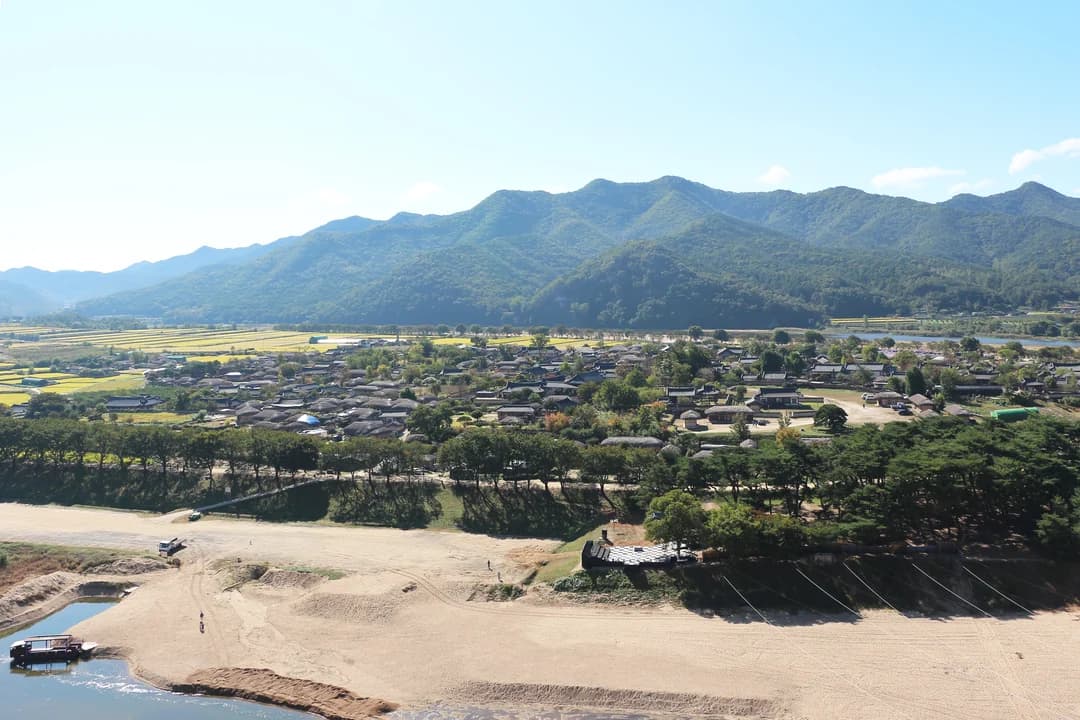
Yangdong, in Gangdong-myeon north-east of the city, is a clan village of the Joseon period. It was inscribed on the World Heritage list in July 2010 together with Hahoe as the Historic Villages of Korea. Two clans shaped it from the 15th century, the Wolseong Son and the Yeogang Yi, whose main houses are Seobaekdang and Mucheomdang. The designated area is about 0.97 km² (474 plots) and was listed as National Folk Heritage in 1984, with the largest number of nationally designated tile-roofed houses in Korea.
Admission is ₩4,000 for adults, ₩2,000 for youths and soldiers and ₩1,500 for children (as of 2026-10-11). Many of the old houses are lived-in family homes, so keep to the lanes, do not enter closed gates and keep voices low. Allow half a day including the trip from the city, and combine it with an afternoon in Gyochon or the east coast.
The east coast: Daewangam, Girimsa and Yangnam
The Munmu Daewang tomb at Bonggil beach is the tomb of King Munmu (reigned 661 to 681), who united the Three Kingdoms: his remains lie in the sea 200 m off the coast, where a natural rock holds channels that let the water flow in from the east and out to the west. About 35 by 36 m of the rock and 5.3 m in height shows above the waves. Access is free, and the Haeryong Sunrise Festival here marks the new year on 31 December and 1 January.
Girimsa, a quiet temple in the hills east of the city, is open 08:00 to 18:00 (to 17:00 in winter) and free to enter, with car parking at ₩1,000 for a car, ₩2,000 for a minivan and ₩3,000 for a large vehicle; it offers temple stays. Nearby Golgulsa and the Yangnam columnar-joint viewpoint can be added on the same coast run. The city's barrier-free route for this side links Bulguksa, the Dongni-Mokwol literature museum, the Daewangam tomb and the Yangnam viewpoint (as of 2026-10-11).
Food: Hwangnam bread, ssambap and local dishes
Gyeongju is known for its small red-bean pastries. Hwangnam-ppang has been made in Hwangnam-dong since 1939, was named a local traditional food in 1994 and is Gyeongbuk Premium No. 2; you can buy it near Daereungwon, the station and the bus terminal. Chalbori-ppang is a soft cake of glutinous barley and whole oats filled with lightly sweet bean paste, Gyeongju-ppang is another red-bean pastry sold by many bakeries, and Juryeonggu-ppang, created in 2012, copies the 14-sided oak die, 4.8 cm across, found at Donggung and Wolji.
For meals, the city runs a local-food brand called Byeolchaeban. Its showpieces are the Six Villages yukgaejang, a spicy beef soup made with Gyeongju beef brisket and tripe, young bracken and other local ingredients, and gondalbi bibimbap, rice with a wild leaf grown in Sannae-myeon, mushrooms and water dropwort, dressed with a soybean-paste and anchovy sauce instead of red-pepper paste. Designated restaurants include the Gyodong ssambap restaurant on Cheomseong-ro, and ssambap, rice and grilled or braised dishes wrapped in fresh leaves, is the classic Gyeongju lunch.
Gyeongju's two traditional markets are Seongdong Market near the former station, called the "upper market", and Jungang Market, the "lower market", which is over a hundred years old and became a permanent market in 1983. Jungang Market still keeps a five-day-market tradition and is livelier on days ending in 2 and 7. The city suggests ending an evening at the Jungang Market night food stalls, about 2.7 km from the palace pond, by taxi or bus if you are tired (as of 2026-10-11).
Festivals and seasonal events
The city's list of regular events gives the usual timing, and dates can shift from year to year. The Gyeongju Cherry Blossom Festival is held around the blossom, usually in early April, at the eastern historic zone and Bomun, with an opening performance, blossom busking and experiences such as wish papers, ringing the Silla Great Bell and costume wear. The Silla Ceramics Festival follows at the end of April, with demonstrations and hands-on pottery. From spring to autumn there are monthly Bomun Hoban healing walks and guided moonlight walks on Namsan and through Silla heritage sites (as of 2026-10-11).
In autumn, the Silla Cultural Festival, the city's main arts festival, takes over the city streets around October, with a main event, theme performances and a re-enactment of how Cheomseongdae was built. Also in October, at Cheomseongdae, come the Silla Sori Festival (Emille-jeon), built around the Divine Bell of King Seongdeok, and the Chungdamjae tea festival with tea ceremony, tea utensils and flower-cake picnics. On 31 December, a bell-ringing event with a chorus of 500 citizens is held at Silla Daejong Park, and the Haeryong Sunrise Festival runs from 31 December to 1 January at Bonggil beach by the Daewangam tomb (as of 2026-10-11).
Dates for next year are announced each year and this guide is updated when they are confirmed. For bad-weather planning, note that spring blossom events move with the weather and that autumn events cluster in October, when hotels and the KTX fill up.
Admission fees and hours at a glance
Adult prices published by the city and the sites: Cheonmachong ₩3,000 (the Daereungwon park itself is free); Donggung and Wolji ₩3,000; combined Daereungwon and Donggung and Wolji ticket ₩6,000; Five Tombs ₩2,000; Poseokjeong ₩2,000; Muyeol-wang's tomb ₩2,000; Yangdong Village ₩4,000; Donggungwon botanical garden ₩5,000. Free: Cheomseongdae, Bunhwangsa, Hwangnyongsa site, Woljeonggyo, Gyochon, the Unification Hall, Bulguksa, Seokguram, Girimsa, the Daewangam tomb and the permanent galleries of the National Museum (as of 2026-10-11).
Free entry applies to children aged six and under, people over 65, disabled visitors (with a carer for the severe grades) and Gyeongju residents at the nine city-run sites, which include Cheonmachong, Donggung and Wolji, Poseokjeong, the Five Tombs and Muyeol-wang's tomb. The Cheonmachong car park charges ₩2,000 for a car and ₩4,000 for a large vehicle, and Donggung and Wolji has free parking. The city's own fee table still lists ₩6,000 for Bulguksa and Seokguram, but the two temples state that admission has been free since 4 May 2023, so rely on the temples' figures (as of 2026-10-11).
Where to stay
Three areas work well. Around Hwangnidan-gil and the tumuli park you can walk to the main sights and the cafes, and the bus terminal is a 5 to 10 minute walk away. The Bomun Lake resort area has the large hotels and condominiums, a flat lakeside path and bus 10 stops at most of them, but it is a bus ride from the downtown sights. The area around the KTX station is convenient for trains but far from everything else. The city lists hotels, condominiums, hanok hotels, auto-camping grounds, guesthouses and pensions (as of 2026-10-11).
Temple stays are offered at Bulguksa and at Girimsa, and the city lists them with other hands-on programs such as costume wear, traditional culture and old-house stays. Book rooms early in the first half of April for the blossom and in October for the autumn festivals.
Accessibility and families
Gyeongju publishes barrier-free information for its main sights. Daereungwon has flat paths, rental wheelchairs and strollers at the front ticket office, a disabled toilet and parking but no nursing room. Donggung and Wolji is mostly flat, though rocks and tree roots lie along the path. The National Museum, Donggungwon and the Expo park all have rental wheelchairs and strollers, lifts, ramps and nursing rooms; the Bomun lakeside path is mostly flat except at one bridge and the stepping stones (as of 2026-10-11).
The city also runs a tourist center for travelers with disabilities, set up in 2005, which recommends courses by disability type and gives guided commentary. It recommends three barrier-free routes: the city center (Daereungwon, Cheomseongdae, Woljeonggyo, the National Museum, Donggung and Wolji), a lakeside walk at Bomun (Donggungwon, the lakeside path, Bomunjeong, the Expo park) and the east side (Bulguksa, the Dongni-Mokwol literature museum, the Daewangam tomb, the Yangnam viewpoint). Families with small children will find the Bird Park at Donggungwon the easiest stop.
Seasons, weather and etiquette
- Winter hours are shorter: from November to January the last entry at Bulguksa and Seokguram is 17:00, Bunhwangsa, Girimsa, the Five Tombs and Poseokjeong close at 17:00, and Cheomseongdae closes at 21:00. Summers are hot, so visit temples and tombs in the morning and the palace pond and Woljeonggyo after dusk.
- At the temples, keep voices low, take off hats in the halls and leave pets outside, since pets are not allowed at Bulguksa or Seokguram.
- Walk only on the marked paths in the tomb parks and do not climb the mounds; arrive well before the closing time at Donggung and Wolji, where crowds can lead to refused entry just before closing; and expect Seokguram to close when a heavy-rain, typhoon or heavy-snow warning is in force.
3-day itinerary
- Day 1, the historic center. Reach the center by city bus or taxi from the KTX station, then visit the National Museum (open 10:00, free), Cheomseongdae and Wolseong, Daereungwon and Cheonmachong (₩3,000), lunch and Hwangnam bread on Hwangnidan-gil, Gyochon and Woljeonggyo, and finish at Donggung and Wolji at dusk (₩3,000, last ticket 21:30; or the ₩6,000 combined ticket with Daereungwon) (as of 2026-10-11).
- Day 2, Bulguksa and Bomun. Take bus 10 from the terminal (35 to 45 minutes) to arrive at Bulguksa at its 09:00 opening (free; last entry 17:30 in October), then bus 12 up to Seokguram (free) and back down on the hourly bus. In the afternoon ride bus 10 to Bomun, visit Donggungwon (closed Mondays), and walk the lakeside path at dusk (as of 2026-10-11).
- Day 3, Namsan and the west. Hire a bike near the tumuli park or use a Tasilla bike for the flat 12 km loop: Woljeonggyo, the Five Tombs (₩2,000), Najeong, Poseokjeong (₩2,000), the Baeri Buddhas and the Samneung pines. Return for Bunhwangsa (free, closes 18:00, 17:00 in winter) and the Hwangnyongsa foundations, and end with the Jungang Market night stalls before your train (as of 2026-10-11).
5-day itinerary
- Day 1: the historic center as in the three-day plan, ending with Donggung and Wolji at dusk. Day 2: Bulguksa at 09:00, Seokguram by bus 12, then Bomun Lake and Donggungwon in the afternoon (closed Mondays) (as of 2026-10-11).
- Day 3: Namsan and the western tombs by bike (about 12 km), with Poseokjeong and the Five Tombs. Day 4: Yangdong Village in the morning (₩4,000), then back to Hwangnidan-gil and Gyochon for the afternoon and Woljeonggyo lit at night. Day 5: the east coast, Girimsa (free, 08:00 to 18:00), the Daewangam tomb at Bonggil beach (free) and the Yangnam columnar-joint viewpoint, before your return train (as of 2026-10-11).
Tips
Use the ₩6,000 combined ticket if you will see both Cheonmachong and Donggung and Wolji on one day, and arrive at Donggung and Wolji well before 21:30 (as of 2026-10-11).
The KTX station is outside the city and the stop called "Gyeongju Station" downtown is the former station; check which one you mean before you board, and store bags in the station lockers or the free Hwangnidan-gil storage.
Bus 10 and bus 11 run in opposite directions round the same loop, and the transfer discount works only when changing to another route. The Hwangnyongsa History Center is closed until 20 November 2026, and Bulguksa and Seokguram have no admission fee but charge for parking.
Sources and last update
Last updated: 11 October 2026. Figures are as of the date shown.
Source: Gyeongju City · Bulguksa Temple · Seokguram Grotto · Gyeongju National Museum · Korea Heritage Service · Checked 11 Oct 2026
Written by HOLIDAY in its own words from official public information. This is not an official publication of the Korea Tourism Organization or any government body.
HOLIDAY refreshes this article regularly as fares, hours and event dates change.